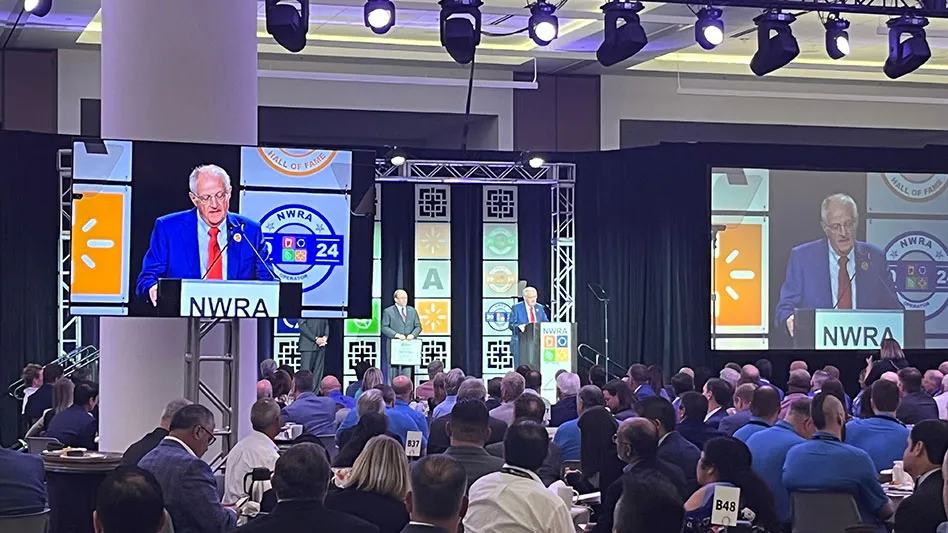
This past week I attended SWANA’s 2013 Senior Executive Seminar in Tucson, AZ, an event I’ve always found stimulating, but never as much as this one, which seems to me to have achieved an epitome in the way of critical mass. Ideas were fissioning at a rate that overwhelmed the time allotted to the program, making me wish that it could have lasted for at least another day.
I was privileged to take part in a panel discussion on nurturing leadership in our operations and found myself thinking of a variety of changes that have been taking place over the past few years.
While I can’t imagine there has ever been such a thing as a stationary target in the composition or needs of our work force, I do believe that today we face changes that demand our total attention. The most obvious example of change is the growing percentage—now nearly two-thirds nationwide—of workers whose primary language is other than English. While those in the Southwestern US have experienced the influx of workers from Mexico and Central America for decades and have developed the programs and procedures for taking advantage of the situation, many in other parts of both the US and Canada find themselves playing catch-up.
While language may be the most obvious feature, other areas such as education, technical knowledge, expectations, and view of authority may pose greater challenges, both immediately and in the long run, since the dynamic we’re experiencing is still in its infancy.
MSW Management has devoted considerable space to the topic, as well as approaches for taking advantage of the change, and you can expect us to step up this activity in the future. Beyond the details of dealing with employee matters, however, lies an even more important area of concern: our underlying vision of how best to accomplish our mission.
Several years back, Nancy Nevil—Solid Waste Manager, past president of SWANA—wrote a Guest Editorial for MSW Management titled, Employees Are Number One, espousing the concept that the way we treat our employees is the way they will treat our customers.
“I believe that if an organization would spend more time and energy on employee satisfaction, customer service and efficiency would follow,” she proposed, and I am convinced she was (and is) spot on target. The rationale for her assertion? “Since frontline workers are usually the best resource for improved efficiency, employees must be a part of the solution to any problem.”
*********************************************************************************
FORESTER UNIVERSITY - UPCOMING CLASSES
Foundation Flood Vent Technology—Weathering the Storm and Improving Building Sustainability, Durability, and Performance
Presenter:
Gary H. Hall, P.E.
President, GHH Engineering Inc.
Wed., Jan. 23th @ 2 p.m. EST / 11 a.m. PST
Protect your buildings and homes from flood damage! Join Gary H. Hall, PE to explore the importance and key installation elements of foundation flood vents complying with the Building Codes and FEMA Regulations, and how they can effectively prevent major damage to buildings due to flooding improving building sustainability, durability, and performance long-term.
[Read full description.]
FREE WEBINAR!
Smart Hydraulic Solutions—
Gain a Competitive Advantage with Your Refuse Collection Equipment
Presenters:
Phil Dybing, Program Manager
Eaton Corporation
Scott Kanne, Executive Vice President
Wayne Engineering
Thurs., Jan. 24th @ 2 p.m. EST / 11 a.m. PST
Stop leaving money at the curb! Join Phil Dybing and Scott Kanne to explore how to drastically reduce your fleet’s fuel consumption and related CO2 emissions, run quieter, increase productivity, and improve truck up-time. In this webinar Dybing and Kanne will discuss the challenges in refuse collection equipment, the opportunities available in smart hydraulic solutions, and how to implement these in your fleet. This session will also include a real-world case study of the country’s fastest growing refuse body OEM, illustrating the positive impact these solutions can have in today’s competitive environment.
[Read full description.]
Green Infrastructure and Community Design—Rainwater Management
Presenter:
Paul Crabtree, P.E., CNU-A
President, Crabtree Group Inc.
Thurs., Feb. 7th @ 2 p.m. EST / 11 a.m. PST
Is your rainwater management design effective? Join Paul Crabtree to discuss how rainwater management based on good urban design principles can help to harmonize urban man and nature. This webinar includes discussion of: effective rainwater management design, the importance of settlement patterns, the use of scales (e.g., watershed), consideration of per-acre and per-capita impacts, harmonization of context-sensitive design and regulations with good urban design, community-based and shared BMPs, and hydrology science vs. negotiated settlements.
[Read full description.]
Voodoo Hydrology—Pitfalls of Urban Hydrology Methods & What You Need to Know
Presenter:
Andy Reese, P.E., LEED AP
Vice-President
AMEC Environment & Infrastructure
Thurs., Feb. 21st @ 2 p.m. EST / 11 a.m. PST
Understand your urban hydrology! Join Andy Reese, PE, LEED AP, as he exposes the black box of urban hydrology and explores its common stormwater methodologies! In this webinar, Andy will, with his normal humor, “lay bare” the key elements, assumptions, and most common misuses of popular urban stormwater methodologies, as well recommendations for proper application of each.
[Read full description.]